Thursday, August 8, 2013

The Exciting Terry Gibbs Big Band 1959

Some of you old school Cryptheads will recall the series we ran on Terry Gibbs big band back at the old Crypt.  During the late 80's, Contemporary reissued several of these fantastic albums originally released on Mercury and Verve.  They dubbed the band the "Terry Gibbs Dream Band" and using new artwork, titled the albums by volume.  As great as their efforts were, they missed this great debut album - Launching A New Band.

This side sounds just as the others do and includes that amazing cast of all star west coast players.  Bill Holman provides the impeccable arrangements.  I would say that overall the band is a touch less frantic when it comes to their pace, but not Gibbs soloing!!!  The vibes are definitely the centerpiece here and Gibbs doesn't disapoint delivering high flying solos everywhere he can.  The tunes run short and yet he somehow still manages to get his chorus' in.

Along with this album, I am including the first volume of Contemporary's Dream Band series.  This album was not a reissue and was infact debuted to ring in this look at Gibbs' big band.  It's a live concert recorded at the Seville in Hollywood from 1959.  This is the same year that "Launching" was released and we find the band giving live treatments of several tunes from the album.  The two albums make a great pair.  Personally, I prefer the live album as the band feels much more loose.

Each album has been ripped at 24/44.1 wav and dithered to 16/44.1 FLAC.  Dream Band is absolute mint with wonderful recording while "Launching" is near mint with great fidelity as well.  If there is interest for me to re-up some of the older Gibbs posts, please let me know in your comments and I will consider it in the upcoming weeks.  Have fun listening to one of the greatest big bands ever assembled...  enjoy!!!

____________________________________________

Launching A New Band

Mercury SR60112
1959

Alto Saxophone – Charlie Kennedy, Joe Maini
Baritone Saxophone – Jack Schwartz
Bass – Joe Mondragon (tracks: A3, A4, B3, B4), Max Bennett (tracks: A1, A2, A5 to B2, B5, B6)
Drums – Mel Lewis
Piano – Pete Jolly
Tenor Saxophone – Bill Holman, Med Flory
Trombone – Bob Enevoldsen, Frank Rosolino, Vern Friley
Trumpet – Al Porcino, Conte Candoli, Phil Gilbert (tracks: A3, A4, B3, B4), Ray Triscari (tracks: A1, A2, A5 to B2, B5, B6), Stu Williamson
Vibraphone – Terry Gibbs

A1 Opus No.1 2:47 
A2 Moten Swing 3:01
A3 I'm Getting Sentimental Over You 2:37
A4 Let's Dance 3:29
A5 Stardust 3:30
A6 Cottontail 2:56
B1 Begin The Beguine 2:30
B2 Jumpin' At The Woodside 2:46
B3 Prelude To A Kiss 3:04
B4 Don't Be That Way 3:55
B5 Midnight Sun 3:28
B6 Flyin' Home 2:53

It is ironic that the Contemporary label came out with five CDs worth of unknown material by the Terry Gibbs Big Band while Polygram has completely neglected its studio sides by the same group. The music on this set, last available as a Trip LP, was the first by Gibbs' "Dream Band," a swinging outfit of top studio musicians who were based in L.A. at the time. This album is comprised of two arrangements apiece by Bill Holman, Bob Brookmeyer, Manny Albam, Al Cohn, Med Flory and Marty Paich, which pay tribute to Benny Goodman, Artie Shaw, Count Basie, Duke Ellington, Lionel Hampton and Tommy Dorsey. The tunes are mostly overly familiar (including "Stardust," "Cotton Tail," "Begin the Beguine" and "Flying Home") and clock in around three minutes, meaning that the solos are quite concise, but there are some good individual moments from the vibraphonist/leader, trumpeter Conte Candoli, and trombonist Frank Rosolino. - Scott Yanow / AMG
____________________________________________________

The Terry Gibbs Dream Band Vol.1

Contemporary C-7647
1986
Recorded live at the Seville, Hollywood 1959

1 Begin The Beguine 2:28
2 Don't Be That Way 6:26
3 Cottontail 3:43
4 Stardust 3:12
5 Opus One 6:00
6 After You've Gone 3:42
7 You Go To My Head 5:17
8 Let's Dance 3:25
9 The Subtle Sermon 8:24
10 Kissin' Bug 4:45
11 Jumpin' At The Woodside 4:30

Alto Saxophone – Charlie Kennedy, Joe Maini
Baritone Saxophone – Jack Schwartz
Bass – Max Bennett
Drums – Mel Lewis
Piano – Pete Jolly
Tenor Saxophone – Bill Holman, Med Flory
Trombone – Bob Enevoldsen, Joe Cadena, Vern Friley
Trumpet – Al Porcino, Conte Candoli, Ray Triscari, Stu Williamson
Vibraphone – Terry Gibbs
The music on this CD, not released for the first time until 1986, features the formerly little-known Terry Gibbs Big Band, an orchestra that worked fairly regularly in Los Angeles from 1959-1962. The repertoire is primarily swing-era standards, but the arrangements (by Bill Holman, Bob Brookmeyer, Al Cohn, Marty Paich, and Manny Albam) are fairly modern for the time; the all-star group's ensembles are tight and such colorful soloists as vibraphonist Gibbs, valve trombonist Bob Enevoldsen, trumpeters Stu Williamson and Conte Candoli, tenorman Bill Holman, pianist Pete Jolly, and altoist Joe Maini are heard from. There would be five CDs released by this band; this is an excellent set to start with. - 4.5/5.0 "Album Pick" Scott Yanow / AMG

Tuesday, August 6, 2013

Coleman Hawkins - Hawk Eyes (1959) [vinyl>flac]

Tenor-great Coleman Hawkins tended to be at his best when challenged by another horn player. On this highly enjoyable album, Hawkins is joined by the superb trumpeter Charlie Shavers and a strong rhythm section that includes guitarist Tiny Grimes and pianist Ray Bryant. With such superior songs as "Through for the Night," "I Never Knew" and "La Rosita," in addition to long jams, plenty of fireworks occur during this frequently exciting session. ~ by Scott Yanow, AMG.

One thing Coleman Hawkins can never be accused of is being dull. His dynamic personality should be the envy of his confreres young and old. Hawk Eyes stands for keen visual perception. In the jazz vernacular it indicates a desire to hear "Bean" (another of Coleman Hawkins' nicknames) play or a general preference for his playing. To have Hawk Eyes in this sense means acute aural perception. ~ excerpts from Liner Notes by Ira Gitler.

Recorded 3rd April, 1959 in Hackensack, New Jersey
Prestige Records, PR 7156, 1959
Prestige Records, PRT 7857, 1971; 1987

Personnel:
Coleman Hawkins - Tenor Saxophone
Charlie Shavers - Trumpet
Ray Bryant - Piano
Tiny Grimes - Guitar
George Duvivier - Bass
Osie Johnson - Drums

Track Listing:
A1. Hawk Eyes {Coleman Hawkins} (10:19)
A2. C'mon In {Coleman Hawkins} (13:18)
B1. Through For The Night {Trummy Young} (5:12)
B2. I Never Knew {Gus Kahn, Ted Fio Rito} (5:44)
B3. La Rosita {Paul Dupont, Allan Stuart} (6:10)
B4. Stealin' The Bean {Osie Johnson} (4:32)

Credits:
Supervisor - Bob Weinstock
Recording Engineer - Rudy Van Gelder
Liner Notes - Ira Gitler; Dan Morgenstern

Sunday, August 4, 2013

The Commodore Years - Tenor Sax: Coleman Hawkins And Frank Wess

I am really excited to be sharing this great album of classic jazz.  This was released in 1973 as part of a reissue program at Atlantic.  They involved Milt Gabler and unlike the overwhelming (but incredible) complete discography that Mosaic released, they selected some of the best performances for this 2LP offering.  For those of you who have the Mosaic set, this post is probably not too interesting but for everybody else - you're in for a real treat!!!


Commodore Records was a United States-based independent record label known for issuing many well regarded recordings of jazz and swing music.  Commodore Records was founded in the spring of 1938 by Milt Gabler, who in 1926 had founded the Commodore Music Shop in Manhattan, New York City, originally at 136 East 42nd Street (diagonally across the street from the Commodore Hotel), and from 1938–41 with a branch at 46 West 52nd Street – an address commemorated in Chu Berry's 'Forty-six, West Fifty-two'. The bulk of Commodore's issues were of Dixieland jazz, though other styles also sometimes appeared on the label. Eddie Condon recorded frequently for the label, with such notables as George Brunies and Pee Wee Russell often

in his band. Commodore was one of the first labels to list the full personnel of bands on the label.
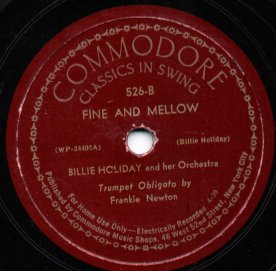
Billie Holiday also recorded for Commodore (in 1939 and 1944), with "Strange Fruit" and "Fine and Mellow" first appearing on that label.
Like his UHCA label, Gabler initially arranged for recording and pressing made by ARC, then Reeves Transcription Services and Decca, so both Commodore and UHCA used various matrix number series, depending on where the session originated from.
After World War II Gabler went to work for Decca Records, and his Commodore label was later used by Decca for reissuing earlier jazz recordings on LP. In the early 1960s a series of Commodore albums were compiled by Gabler and part of the Mainstream label. Mosaic Records issued three LP sets of the label's complete output. - Wikipedia


The whole album is great, even the alternates.  My copy is mint condition and was ripped at 24/44.1 wav, dithered to 16/44.1 FLAC.  The anomolies you may hear are from the source recordings. Aside from that the fidelity on these recordings is brilliant, especially considering the age!!  I am assuming they did some
ripping of their own to get all of this music together!!  Enjoy!!


This attractive two-LP reissue (whose contents have since been reissued in Mosaic's massive Complete Commodore Jazz Recordings box set) consists of four interesting swing sessions. The first two are quite classic. The great tenor saxophonist Coleman
Hawkins is heard with a pianoless sextet in 1940 that also stars altoist Benny Carter and trumpeter Roy Eldridge. Their four selections (plus two alternate takes) are all impressive but it is this brilliant version of "I Can't Believe That You're in Love with Me" (during which Carter takes solo honors) that is most memorable. The other Hawkins date is with a septet from 1943. Trumpeter Cootie Williams and clarinetist Edmond Hall are in fine form, but it is the participation of the remarkable pianist Art Tatum that makes the set particularly historic. The other two sessions, among the final ones for Commodore, showcase Frank Wess (on tenor and 
flute) with a variety of Count Basie's sidemen (including trombonists Henry Coker, Benny Powell and Urbie Green, trumpeter Joe Wilder and pianist Jimmy Jones) on some lightly swinging modern jazz.     -  4.5 / 5  Scott Yanow/AMG

Friday, August 2, 2013

Dexter Gordon - Homecoming (LP rip)

Ahhhh yes, it is actually me over here for a moment! Given the major sparks being thrown off this last week by all my beloved blog-mates, I just HAD to chip in with a bit of a firework of my own!

My coffee mate Cliff has pointed out to me that this particular album is more than a little over-looked in the Dex catalog, largely due to some unfortunate decisions at Columbia/Sony. Clifford recently went and bought a crispy promo copy of the original LP and gave it to me to rip; couldn't leave y'all out of the Lagniappe.

These marvelous live tracks were recorded shortly after Dex's return from Europe but I seem to recall there was a Xanadu date just prior to this. In a surprising but savvy move, Dex chose to play his first Vanguard booking with Woody Shaw and his magnificent working band of the time.

Michael Cuscuna and Columbia had the good sense to show up and record the gigs and this very well received double album set (subsequently released in 1977) was the fortunate result. Now comes the confusing part.....Despite the relative popularity (jazz-wise) of both Dex and Woody in the ensuing years, this album sees only two pressings and then disappears from print until 1990. In 1990 Columbia reissues the set with two additional tunes on a double disc CD. Great news, eh? Well....not so much... do you remember those first Columbia digital remasters on the blue cover Jazz Masterpieces series? Do you remember the way they absolutely butchered their first CD issue of Kind Of Blue? They may have done an even worse job on their reissue of this jewel! Even more baffling is the idea that they have yet to rectify this travesty to this day!

Soooo...here we are - my buddy scored this lovely copy and I've ripped it to FLAC, of course. We enter the Way-Back Machine to 1976 at the Village Vanguard, the bill says Dexter Gordon, Woody Shaw, Ronnie Mathews, Stafford James and Louis Hayes....You buying a ticket?

Thursday, August 1, 2013

Stuff Smith ~ Dizzy Gillespie ~ Oscar Peterson (1957)


This exemplary reissue from 1994 is long out of print and I can't imagine that it will see a reissue except on some European out of copyright label - excellent sound from the original master tapes, full discographical info, liner notes, artwork - all praise to Polygram!

Stuff Smith - Have Violin Will Swing (Verve MGV 8282)

Carl Perkins (piano) Stuff Smith (violin) Curtis Counce or Red Callender (bass) Frank Butler or Oscar Bradley (drums)
Capitol Tower Studios, Hollywood, CA, January 21 & February 5, 1957

1-01 - It's Wonderful
1-02 - Comin' Thru The Rye
1-03 - Ja-Da
1-04 - (Back Home Again In) Indiana
1-05 - Calypso
1-06 - Blow, Blow, Blow
1-07 - I Wrote My Song
1-08 - Oh, But It Is
1-09 - Stop, Look
1-10 - Would You Object
1-11 - Crazy Rhythm

Stuff Smith (Verve MGV 8206)

Oscar Peterson (piano) Barney Kessel (guitar) Stuff Smith (violin) Ray Brown (bass) Alvin Stoller (drums)
Glen Glenn Studios, Hollywood, CA, March 7&12, 1957

1-12 - Desert Sands.
1-13 - Soft Winds.
1-14 - Things Ain't What They Used To Be.
1-15 - Time And Again (Aka 'don't You Think').
1-16 - I Know That You Know.
2-01 - It Don't Mean A Thing (If It Ain't Got That Swing).
2-02 - In A Mellotone.
2-03 - Heat Wave.
2-04 - Body And Soul.

Dizzy Gillespie And Stuff Smith (Verve MGV 8214)

Dizzy Gillespie (trumpet) Wynton Kelly (piano) Stuff Smith (violin) Paul West (bass) J.C. Heard (drums)
NYC, April 17, 1957

2-05 - Rio Pakistan.
2-06 - It's Only A Paper Moon.
2-07 - Purple Sounds.
2-08 - Russian Lullaby.
2-09 - Oh, Lady Be Good!.


Review by Richard Palmer, Jazz Journal, February 1995:

This handsome and generous package collates three of Stuff Smith's finest IPs, recorded within three months of each other—Have Violin, Will Swing, Stuff Smith and Dizzy Gillespie and Stuff Smith. The first named, in particular, has long been a £50-plus collector's item, so to have it available with its two splendid companions for under £15 is welcome indeed.
In my view, Stuff was and remains by some distance the finest violinist jazz has produced, Amongst his rivals, only Nance and Ponty got anywhere near his marvellous sound—sonorously melodious, yet resonating with the kind of joyously sneering insolence that one associates with tenorist Lockjaw Davis. In addition, while nobody has remotely approached him for virility of swing or harmonic imagination, he had subtler qualities that captivate always, without slipping into the kind of saccharinity that jazz violin can be prone to. Stuff was a very special talent noticeably under-recorded almost throughout his career, and jazz owes Norman Granz a very large round of thanks for resuscitating his career when and in the way he did.
The two-and-a-half hours' music on offer is remarkably consistent in both inspiration and delivered satisfaction. All three pianists are marvellous: Perkins, especially, is a revelation, and it is sad to reflect on how little studio work he got, too. Particularly rewarding tracks from this date are Rye, where Stuff switches from blithe lyricism to red-blooded stomping with insouciant mastery, and virtually all the cuts with the great Red Callender—most of them Smith's own compositions that reflect his no-nonsense yet intriguingly sophisticated personality. The Peterson tracks are flawless, with Brown's remastered sound colossal and Kessel at the very top of his game: Desert Sands and Soft Winds are the pick here, though the three * tracks are valuable additions.
Nearly 40 years on, the Gillespie session still strikes one as breathtakingly audacious. Dizzy was from the start one of the most catholicly literate musicians jazz ever produced (only Ellington surpasses him in boldness of range and sure-footed encyclopedic eclecticism); even so, a trumpet-violin front line was taking quite a chance, and put a burden on Kelly which that wonderful West Indian shoulders triumphantly. Rio is I think the outstanding track, with Heard magnificent and the two horns exceptional both in solo and in partnership, but Lullaby and Moon are hardly less fine. The final cut with the Gordon Family's added vocalising isn't too bad, all things considered, but it is a pronounced anti-climax, and the only thing on the entire double-CD that in retrospect looks like a mistake. By then, however, it doesn't really matter.
Verve's releases over the last 18 months or so have been the best and noblest possible tribute to the man who founded the label and who is synonymous with all that is best in modern-mainstream. There could be no better or more fitting tribute to Norman Granz's enterprise, daring and imagination than this particular reissue, and it would also be hard to think of a more enjoyable and instructive one. A 1995 Top Ten choice for sure.

Wednesday, July 31, 2013

Rex Stewart - Rendezvous With Rex

This interesting and well-rounded LP has two separate sessions originally cut for the Felsted label. Cornetist Rex Stewart is fiery on the first date, jamming on a trio of his worthy but obscure originals (when was the last time anyone played "Tillie's Twist" or "Tell Me More?") with trombonist George Stevenson, Haywood Henry (on clarinet and baritone), tenorman George Kelly, either Willie "The Lion" Smith or Dick Cary on piano, bassist Leonard Gaskin and drummer Arthur Trappier; Stewart takes a pleasant vocal on "My Kind of Gal." The three numbers from the later date have moody arrangements by Cary (who doubles on trumpet) and find Stewart in a septet with Hilton Jefferson (heard on clarinet and alto), clarinetist Garvin Bushell (whose bassoon work makes the date most memorable), guitarist Everett Barksdale, bassist Joe Benjamin and drummer Mickey Sheen. Superior music that will hopefully resurface on CD someday. - Scott Yanow/ AMG


Felsted FAJ 7001
1958

A1   Tillie's Twist
A2   Pretty Ditty
A3   Tell Me More
B1   Danzon D'amor
B2   My Kind Of Gal
B3   Blue Echo

Alto Saxophone – Hilton Jefferson (tracks: A2, B1, B3)
Baritone Saxophone – Haywood Henry (tracks: A1, A3, B2)
Bass – Joe Benjamin (tracks: A2, B1, B3), Leonard Gaskin (tracks: A1, A3, B2)
Bassoon – Garvin Bushell (tracks: A2, B1, B3)
Clarinet – Garvin Bushell (tracks: A2, B1, B3), Haywood Henry (tracks: A1, A3, B2), Hilton Jefferson (tracks: A2, B1, B3)
Cornet – Rex Stewart
Drums – Arthur Trappier (tracks: A1, A3, B2), Mickey Sheen (tracks: A2, B1, B3)
Guitar – Everett Barksdale (tracks: A2, B1, B3)
Piano – Dick Cary (tracks: A2, B1, B2, B3), Willie "The Lion" Smith (tracks: A1, A3)
Tenor Saxophone – George Kelly (tracks: A1, A3, B2)
Trombone – George Stevenson (tracks: A1, A3, B2)
Trumpet – Dick Cary (tracks: A2, B1, B3)
Vocals – Rex Stewart (tracks: B2)

Tuesday, July 30, 2013

Freddie Hubbard - Sweet Return (1983) [vinyl]

I haven't seen a CD reissue of this outside of Japan?

Review by Richard Palmer, Jazz Journal, July 1984:

The title is apt. It commemorates not only Freddie's return to Atlantic after an absence of 12 years, but also a reunion with the kind of material and approach that originally established him as a major jazz talent.
Just a glance at the personnel tells you most of what you need to know about the music on the date, which is predictably wonderful, and also richly varied in its challenges. Gomez is simply awesome — at home in every context, his vast sound propelling everything and everyone, and his solos are models of imagination and structure. Brackeen contributes the date's most ambitious composition, Heidi-B, and I find her rollicking work on the joyous Calypso particularly noteworthy. Tabackin is equally convincing on both tenor and flute, and it is especially nice to hear his talents spread so richly in a smaller ensemble. And as for Haynes ... he just seems to get better and better, a master of controlled and sympathetic aggression, and still one of the greatest practitioners of brushes. Freddie himself is in absolute top form here. Whether it be his happy bubbling on Calypso, his darkly romantic reading of Misty, or his richly creative excursions on both tracks on the second side, this date proves with every note that he is indisputably one of jazz's true heavyweights. By no means miss this one.

1. Sweet Return
2. Misty
3. Whistling Away The Dark
4. Calypso Fred
5. Heidi-B
6. The Night Has A Thousand Eyes

Freddie Hubbard (t); Lew Tabackin (ts/fl); Joanne Brackeen (p); Eddie Gomez (b}; Roy Haynes (d); Hector Manuel Andrade (perc).
NYC, June 13 & 14, 1983.

Monday, July 29, 2013

Herbie Mann - Glory Of Love (1967) [vinyl>flac]

Flutist Herbie Mann is backed by a large rhythm section and a small horn section on this Creed Taylor-produced A&M set (which has been reissued on CD). Actually the most interesting aspect of the R&B-oriented date (which includes such songs as "Hold on, I'm Comin'," "House of the Risin' Sun" and "Unchain My Heart") is that the up-and-coming flutist Hubert Laws is matched with Mann on several tracks.  ~ by Scott Yanow, AMG.

This album is from Taylor's A&M period, and fronted by flautist Herbie Mann, it features a stellar line-up of soul-jazz studio musicians. There's a lot of pop soul here, and a sampling of the latin styles that both Mann and Taylor were known for. You'll find young Roy Ayers and Sonny Sharrock here (dig Ayers' awesome vibes solo on the cover of soul hit "The Letter" for a virtual blueprint of his Ubiquity sound). Listen to Ayers and Sharrock duet on the cover of "Hold On I'm Coming" over the unrelenting funk of Grady Tate on drums. Edu Lobo's "Upa Neguinho" gets a terrific treatment. The title track is pure CTI schmalz. And capitalizing off Taylor's eye for turning adult pop hits into jazz is "Love Is Far Stronger than We" covered from the A Man And A Woman soundtrack. "Oh How I Want To Love You" is a slinky sexy grind of a song, and, gasp, actually a Herbie Mann original.

CTI/A&M, SP-3003, 1968
Recorded 26th (#A1,A3,A4,A5,B3), 27th (#B4) July; 19th (#B1) September;
6th (#A2,A6,B2) October, 1967 at Van Gelder Studios, New Jersey

Track Listing:
A1. No Use Crying {Roy Gaines, Freddie Kober, Johnnie Daniels} (3:03)
A2. Hold On, I'm Coming {Isaac Hayes, David Porter} (3:11)
A3. Glory Of Love {Billy Hill} (2:41)
A4. Unchain My Heart {Freddy James, Agnus Jones} (3:09)
A5. House Of The Rising Sun {Traditional} (3:08)
A6. The Letter {Wayne Carson} (3:22)
B1. Upa, Neguinho {Edu Lobo, Gianfrancesco Guarnieri} (2:40)
B2. Love Is Stronger Far Than We {Pierre Barouh, Francis Lai, Jerry Keller} (3:10)
B3. Oh, How I Want To Love You {Herbie Mann} (5:31)
B4. In And Out {Herbie Mann} (4:33)

Personnel:
Herbie Mann - Flute
Hubert Laws - Flute, Piccolo Flute (#A1,A3,A4,A5,B1,B3,B4)
Joe Grimaldi - Saxophone (#B1)
Benny Powell - Trombone (#B1)
Burt Collins - Trumpet, Flugelhorn (#B1)
Ernie Royal - Trumpet, Flugelhorn (#B1)
Roy Ayers - Vibraphone (#A2,A6,B2)
Ted Sommer - Vibraphone (#B1)
Paul Griffin - Piano (#B1)
Roy Glover - Piano (#A1,A3,A4,A5,B3,B4), Organ (#A1,A3,A5,A5,B3,B4)
Roland Hanna - Piano (#B4), Organ (#B4)
Eric Gale - Guitar (#A1,A3,A4,A5,B1,B3)
Jay Berliner - Guitar (#B1)
Sunny Sharrock - Guitar (#A2,A6,B2)
Ron Carter - Bass (#A1,A3,A4,A5,B1,B3,B4)
Earl May - Bass (#A2,A6,B2)
Grady Tate - Drums (#A1-A6,B2-B4)
Herb Lovelle - Drums (#B1)
Johnny Pacheco - Percussion (#B1)
Ray Barretto - Percussion (#B1)
Ted Sommer - Percussion (#B1)

Plus Horns and Unidentified Chorus

Credits:
Producer - Creed Taylor
Recording Engineer - Rudy Van Gelder

Don Byas - Ballads For Swingers (1966) [vinyl]

This is from vinyl. Part of a collection recently acquired by Danair, who lacks the facilities to rip LPs so he's sending them for me to do. The first, hopefully, in a series!

Born in 1912, Byas served his apprenticeship in a variety of big bands. Like most tenor players of his generation his style was heavily indebted to that of Coleman Hawkins, particularly in its fullness of tone. However, he soon developed his harmonic range and became interested in the then developing bop style. Often considered to be a bridge between the swing and bebop generations, he often anticipates Charlie Parker's solo development, stringing together whole series of tiny melodic ideas into a coherent line with a challenging harmonic profile.

He went to Europe in 1946 and spent the remainder of his life there until his death in Amsterdam in 1972. In later life he was a fine ballad player. Albert McCarthy in the book “Jazz On Record” published in 1968, suggested that he appeared to introduce elements from the playing of John Coltrane and Sonny Rollins into his style, citing the tracks “Lady Bird” and “All The Things You Are” from this album as evidence. He summarised – “At his best, Byas can be rated as one of the greatest ballad performers on his instrument”.

01 - Yesterdays
02 - All The Things You Are
03 - Lady Bird
04 - Lover Man
05 - I'll Remember April

Don Byas (ts) Bengt Axen (p) Niels Henning Orsted Pederson (b) Axel Riel (d) but see below
Café Montmartre, Copenhagen.

Thanks to Chu:

According to Lord, this was recorded on 13-14 January 1963 (one night) and the drummer is William Schiøpffe. This together with much more from the same night was once released on two Black Lion CDs entitled "A Night In Tunisia" and "Walkin'".

Sunday, July 28, 2013

Junior Mance - Holy Mama

Today's offering is one of my favorite albums by our main man, Junior Mance.  Recorded in the late 70's, we are getting a snapshot of his best work in my opinion.  The older Riverside and Jazzland sides may be more attractive, but musically Mance is world's ahead by this point in his career.  I wanted to share this side a few years back but it had been reissued to CD.  It appears that it has gone OOP.

Holy Mama is really a showcase for both Mance and Martin Rivera, his bassist.  Sal LaRocca comps accordingly and does an amazing job keeping up with his partners - no easy task.  Overall, the dynamics on Holy Mama really speak to an excellent recording, but also to a trio with great abilities.  From the softest whisper to a lion's roar within a moment's notice, they capture one of the great essences of acoustic jazz.

The opener is a great example of what to expect from this album.  "By The Time I Get To Pheonix" explores just about every emotion and groove that Mance has to offer.  The way in which they change the time signatures, to the way they change the feel is something only the greatest of musicians are capable of.  The group are rooted in swing but use everything available to them;  from funk to blues.  I think that Rivera really deserves a shout out as he shows himself to be a bassist of the highest caliber.  Really, would a player like Junior Mance work with anything less?  Rivera's solo on "That Mellow Feeling" displays not only an immaculate sense of groove and feel, but amazing dexterity and mastery of his instrument.  I find when he takes a solo, I want to yell out to him and encourage him.  He seems to play right to the edge of chaos - where a player loses himself but of course, he always stays in the tune, fully composed.

Holy Mama was ripped from minty vinyl at 24/44.1 wav and dithered to 16/44.1 FLAC.  I have changed my methods a tad and now use FLAC Frontend to convert from wav.  All scans are still included in 300dpi quality.  For several reasons, I had shy'd away from ripping vinyl - only now and again.  I am now reborn and plan on flooding the Crypt with the huge backlog of albums I have.  I hope everyone digs this Sunday offering... enjoy!!!

___________________________________________________________

Inner City Records
IC 6018
1979

Bass – Martin Rivera
Drums – Salvatore LaRocca
Piano – Junior Mance


A1 By The Time I Get To Phoenix
Written-By – Jim Webb* 7:30
A2 God Bless The Child
Written-By – A. Herzog Jr.*, B. Holiday* 8:17
A3 That Mellow Feeling
Written-By – Junior Mance 7:13 

B1 Holy Mama
Written-By – Junior Mance 5:20
B2 Miss Otis Regrets
Written-By – Cole Porter 2:56
B3 The Good Old Days
Written-By – Junior Mance 5:57
B4 Blues For The Schnug
Written-By – Junior Mance 6:44

Sunday, July 21, 2013

Cozy Cole - Cozy's Caravan & Earl Hines - Earl's Backroom

Ahhhhhh, home sweet home.  I may show up at different blogs, shoot....  I even have my own - but nothing, N-O-T-H-I-N-G compares to the Crypt.  I decided to take a short "blogcation" (yes I invented this word), which in turn became quite a long blogcation.  It was nice being able to just listen to some music that had been piling up, and simply chill out when logged on.  But enough of that, onto the music!!!

I want to continue where we left off and get the rest of this incredible series posted.  This album is really two sides in one, a split LP.  While on the topic, you should know that I have tagged it as such so don't be surprised to see two albums appear in your media player.

For fans of Cozy Cole, I don't think you will find a greater album than this.  First of all, the fidelity alone makes it a hot ticket.  Much of his early work suffers from poor recording.  This album also allows him some real space to hit ya with what he's got.  His solo during Caravan is an incredible example of his skill.  Cozy is in no rush and builds it slowly, deliberately creating that wonderful tension until he finally explodes before the band bring back the chorus.  Overall, like much of this series, we are treated to vocals and blues in a jazz jam setting.

As for the Earl Hines side, we are treated to a small quartet session featuring the little known horn player, Curtis Lowe.  Like many of his albums, these tunes are rooted in the blues and have a real jam flavour.  All 3 tracks are solid and exemplify Hines at his best.

With both of these sides combined, we get quite a strong album.  One theme that runs throughout??  FUN!!!  It's all upbeat and lighthearted which is a side of jazz I certainly love.  This was ripped from disc using EAC to 16/44.1 FLAC, 24 bit remastering, mmmmmmmm tasty Crypt BBQ anybody??? ...  enjoy!!!


Earl Hines Quartet - Earl's Backroom
Felsted FAJ 7002

01. Brussels’ Hustle (Hines) 7:59
02. Oooh! (Hines) 5:03
03. Backroom at the Villa d’Este (Hines) 6:49

Cozy Cole Septet - Cozy's Caravan
Felsted FAJ 7002

04. Caravan (Tizol-Ellington) 9:58
05. Phatz’ Blues (Morris-Thompson) 5:16
06. Margie (Davis-Conrad-Robinson) 4:26

Earl Hines Quartet:
Curtis Lowe (ts, bs), Earl Hines (p), Charles Oden (b), Earl Watkins(d).
Recorded in San Francisco, on February 3, 1958.

Cozy Cole Septet:
Lou Jones (tp), Walter 'Phatz' Morris (tb, hmca on #5), Boe McCain (ts), Reuben Jay 'June' Cole (p), Dickie Thompson (g, vcl), Peter Compo (b), Cozy Cole (d).
Recorded in New York City, on February 7, 1958.

Friday, July 19, 2013

Johnny "Hammond" Smith with Lem Winchester - Gettin' The Message (1960)

Organist Johnny "Hammond" Smith's fourth album as a leader, 1961's Gettin' the Message, pairs him with vibraphonist Lem Winchester; Smith and Winchester recorded together fairly often around this period, and the rather unique combination of mellow vibes (an instrument most often associated with cool jazz and Milt Jackson's dignified work with the Modern Jazz Quartet) and funky organ (then rising in popularity, along with what would soon be called soul-jazz) is an interesting blend of styles. The two trade solos in front of a standard hard bop rhythm section that hogs little of the listener's attention, but unfortunately never rises much beyond a mild simmer. While this is fine for tunes like the mellow opener, "Dementia," songs like "Lid Flippin'" and even that hoary old "Swanee River" sound like they could stand to be goosed along a bit; there's a big difference between cool and cold. Aside from that flaw, however, this is a solidly entertaining and texturally intriguing album. ~ by Stewart Mason, AMG.

Prestige Records, PR 7217, 1960
Recorded 14th October, 1960 at Rudy Van Gelder Studio, Englewood Cliffs, New Jersey

Personnel:
Johnny "Hammond" Smith - Organ
Lem Winchester - Vibraphone
Eddie McFadden - Guitar
Wendell Marshall - Bass
Bill Erskine - Drums

Track Listing:
A1. Swanee River {Traditional} (8:54)
A2. Just Say So Long {Johnny "Hammond" Smith} (4:00)
A3. Lid Flippin' {Johnny "Hammond" Smith} (5:14)
B1. Gettin' The Message {Johnny "Hammond" Smith} (7:12)
B2. Princess {Johnny "Hammond" Smith} (5:28)
B3. Dementia {Johnny Burke, Erroll Garner} (5:18)

Credits:
Supervisor - Esmond Edwards
Recording Engineer - Rudy Van Gelder
Liner Notes - Sidney Falco

Johnny (Hammond) Smith with Lem Winchester, Prestige PRLP 7217 - Johnny (Hammond) Smith has perhaps his best LP effort to date here. The formidable jazz organist has always been a swinger of the first rank, but on this set he also shows first-class showmanship and taste. The addition of the late Lem Winchester adds a touch of contemplation which gives the instrumental sound distinctiveness – much like a funky Modern Jazz Quartet. The album is neatly divided into a variety of moods with “Swanee River,” “Gettin’ the Message” and “Princess” among the top tracks. ~ Billboard Magazine (May 12, 1962, page 24)

Wednesday, July 17, 2013

Mike Nock - Strata

Another Mike Nock date from 'wightdj' and at the time he sent it, I'd never even heard about this one. The album is a New Zealand release on the Kiwi label that does not appear to have seen any international distribution. In other words, not easy to find!

The record is primarily a solo effort but there is some nice percussion accompaniment on a few cuts. Nock plays some Fender Rhodes and synthesizer as well as piano on this captivating music that was written for a feature film of the same name. There is a definite mood established in this music, it's easy to imagine it accompanying a movie.

This is a rare one, don't miss it and don't forget to thank wrightdj for your good fortune in obtaining a copy of this treasure.

Tuesday, July 16, 2013

Mike Nock - Ondas

I'd call this one of the overlooked masterpieces of ECM. Rarely have piano trios produced such astounding conversations, this is the territory of  Evans/LaFarro/Motian or Jarrett/Haden/Higgins, hallowed ground indeed, but I have no problem elevating this album to that status. You can read Thom Jurek's ecstatic review, but first here are Mike's memories:

"Manfred wrote me a letter after hearing In Out and Around, saying he wished that album had been on ECM and telling me he wanted to make a trio recording with Gomez, Christensen and myself.
I played quite often with Gomez on recordings and tours, but never with Christensen.
The first day in the studio the trio played quite differently - free high energy jazz, which was erased before I even heard it!  I loved the session but Manfred seemed disinterested.
The next morning he got up at dawn and we began recording around 9am.  By 11am we were finished as he knew he had what he wanted.
It was a very collaborative session.  The first piece; ‘Shadows of Forgotten Love’ was on In Out and Around but Manfred had his own vision for the piece, suggesting I just play the first 16 bars and forget about the bridge section.  We finished the first take and I saw Manfred gesticulating wildly in the control room for us to continue - which we did and which you can actually hear on the recording.  It was all very spontaneous and a wonderfully unusual collaborative experience for me.
I was very much into Brazilian music and culture at the time ('Ondas' means 'waves' in Portuguese) but interestingly enough I came up with the title while on one of my frequent visits to Nelson NZ, situated on Golden Bay.
Manfred loved the title, as apart from the sound of the word it also had a somewhat enigmatic quality, as he felt very few people would know what it actually meant".
Mike Nock - September 15, 2010

Mike Nock celebrated his 70th birthday on September 27, 2010.

I've got to say that I mourn that first session that Manfred erased so preemptively, how nice would it be to have a companion album with a completely different feel?

Sunday, July 14, 2013

Mike Nock - Succubus

 An odd little chapter in Nock's albums, as evidenced by the cover that would have you expecting some Goth-Metal band or other such, but this 1980 release on Sutra Records was relatively mainstream jazz for the time. At the end of the day the album attempts to straddle too many fences to be much more than interesting for me, but if you are a big fan of later Weather Report then I'm guessing you may well love this.

This rip comes from a young Swedish guy named Gustav, who posted it a few years back.

Thursday, July 11, 2013

Mike Nock - Piano Solos 1978


More brilliant solo work from one of my favorite piano players. There is a sparkle to Nock's solo playing that I find irresistible, he is a painter, a poet, as good as any of his peers at this art-form (solo piano).

This first ran at the old Crypt some 4 years ago and it came then as a gift from wrightdj.