Showing posts with label Al Casey. Show all posts

Thursday, April 23, 2020

Al Casey - The Al Casey Quartet (1960)

Albert Aloysius Casey, guitarist and bandleader: born Louisville, Kentucky 15 September 1915; married (one son); died New York 11 September 2005. Casey came from a musical family and was forced to learn the violin. He hated the sound of it and as soon as he could jettisoned it for the ukulele. Once in New York he studied guitar at DeWitt Clinton High School before his uncles sent him to the Martin Smith Music School for three years.

During the first part of his career Casey played a mainly chordal style on the guitar and it was only later, after Fats Waller's death in 1943, that he concentrated on electric guitar and the delightful single string solos that swung so much. He had such a powerful ability to swing that he had no need for complex solos and compared to other guitarists used a minimum of notes. This style can best be heard on the remarkably swinging blues feature that he recorded with Waller "Buck Jumpin' " (1941). This was a big hit at the time and Casey continued to play it regularly for the rest of his career. As far as could be judged it never lost any of its irresistible swing in later performances. ~ Extract by Steve Voce, Independent.co.uk.

Moodsville Records, MVLP 12, 1960
Recorded 10th November, 1960 Van Gelder Studio, Englewood Cliffs, New Jersey

Musicians:
Al Casey - Guitar
Lee Anderson - Piano
Jimmy Lewis - Bass
Beltan Evans - Drums

Tracks:
A1. Blue Moon {Richard Rodgers, Lorenz Hart} (4:35)
A2. These Foolish Things {Harry Link, Jack Strachey, Eric Maschwitz} (6:45)
A3. All Alone {Irving Berlin} (5:25)
B1. Don't Worry About Me {Rube Bloom, Ted Koehler} (5:51)
B2. Dancing In The Dark {Howard Dietz, Arthur Schwartz} (4:23)
B3. I'm Beginning To See The Light {James, Ellington, Hodges, George} (4:47)
B4. A Case Of Blues {Jimmy Lewis} (2:52)

Total Time: 34:38

Credits:
Recording Engineer - Rudy van Gelder
Liner Notes - Joe Goldberg

Sunday, August 4, 2013

The Commodore Years - Tenor Sax: Coleman Hawkins And Frank Wess

I am really excited to be sharing this great album of classic jazz.  This was released in 1973 as part of a reissue program at Atlantic.  They involved Milt Gabler and unlike the overwhelming (but incredible) complete discography that Mosaic released, they selected some of the best performances for this 2LP offering.  For those of you who have the Mosaic set, this post is probably not too interesting but for everybody else - you're in for a real treat!!!


Commodore Records was a United States-based independent record label known for issuing many well regarded recordings of jazz and swing music.  Commodore Records was founded in the spring of 1938 by Milt Gabler, who in 1926 had founded the Commodore Music Shop in Manhattan, New York City, originally at 136 East 42nd Street (diagonally across the street from the Commodore Hotel), and from 1938–41 with a branch at 46 West 52nd Street – an address commemorated in Chu Berry's 'Forty-six, West Fifty-two'. The bulk of Commodore's issues were of Dixieland jazz, though other styles also sometimes appeared on the label. Eddie Condon recorded frequently for the label, with such notables as George Brunies and Pee Wee Russell often

in his band. Commodore was one of the first labels to list the full personnel of bands on the label.
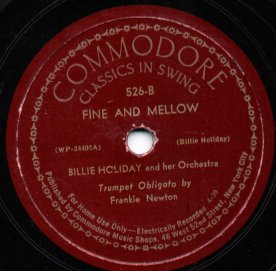
Billie Holiday also recorded for Commodore (in 1939 and 1944), with "Strange Fruit" and "Fine and Mellow" first appearing on that label.
Like his UHCA label, Gabler initially arranged for recording and pressing made by ARC, then Reeves Transcription Services and Decca, so both Commodore and UHCA used various matrix number series, depending on where the session originated from.
After World War II Gabler went to work for Decca Records, and his Commodore label was later used by Decca for reissuing earlier jazz recordings on LP. In the early 1960s a series of Commodore albums were compiled by Gabler and part of the Mainstream label. Mosaic Records issued three LP sets of the label's complete output. - Wikipedia


The whole album is great, even the alternates.  My copy is mint condition and was ripped at 24/44.1 wav, dithered to 16/44.1 FLAC.  The anomolies you may hear are from the source recordings. Aside from that the fidelity on these recordings is brilliant, especially considering the age!!  I am assuming they did some
ripping of their own to get all of this music together!!  Enjoy!!


This attractive two-LP reissue (whose contents have since been reissued in Mosaic's massive Complete Commodore Jazz Recordings box set) consists of four interesting swing sessions. The first two are quite classic. The great tenor saxophonist Coleman
Hawkins is heard with a pianoless sextet in 1940 that also stars altoist Benny Carter and trumpeter Roy Eldridge. Their four selections (plus two alternate takes) are all impressive but it is this brilliant version of "I Can't Believe That You're in Love with Me" (during which Carter takes solo honors) that is most memorable. The other Hawkins date is with a septet from 1943. Trumpeter Cootie Williams and clarinetist Edmond Hall are in fine form, but it is the participation of the remarkable pianist Art Tatum that makes the set particularly historic. The other two sessions, among the final ones for Commodore, showcase Frank Wess (on tenor and 
flute) with a variety of Count Basie's sidemen (including trombonists Henry Coker, Benny Powell and Urbie Green, trumpeter Joe Wilder and pianist Jimmy Jones) on some lightly swinging modern jazz.     -  4.5 / 5  Scott Yanow/AMG