Showing posts with label Edmond Hall. Show all posts

Thursday, September 17, 2015

Various Artists - Dixieland Main Stem New Orleans

Wait!!!  Don't scroll yet!!!

I know it says "Dixieland" and you are probably uninterested, but there's more than meets the eye here.  This is a recording of a live show at the Savoy Cafe in Boston, 1949.  The music is essentially mainstream, but more of a hot jazz/Chicago style, and the tunes are far from typical Dixie fare.  The Dixieland in the title would have been more for marketing than representation.

That said, this album is a really fun romp which maintains a jam feel throughout.  Side 2 plays like a medley, right up to Limehouse Blues which is infact a superb drum solo by Crawford.  Crawford's solo is a real banger too, something to behold.  Everybody gets a ton of shine, including Braff who is described as "new to the jazz scene" in the notes.  

The crooked cover is due to the application of the stickered sleeve, which was done at the factory.  Like most live recordings from this era (originally on 78), the sound quality is far from perfect.  However I think it's more than listenable.  I won't share anything which doesn't meet a certain standard.  The music is super fantastic and enjoyable as such.  This was ripped at 24/48 wav and transferred to 24/48 FLAC for your convenience.  I have it tagged under Edmond Hall.  As you probably assumed, it's in glorious mono... enjoy!!!

Regent MG 6076
"Savoy Cafe", Boston, MA, 1949

Ruby Braff (trumpet) Vic Dickenson (trombone) Ed Hall (clarinet) Kenny Kersey (piano) John Field (bass) Jimmy Crawford (drums)

Careless love
Please don't talk about me when I'm gone.
Bugle call rag.
Black and blue.
When a woman loves a man.
You made me love you.
My ideal.
Limehouse blues.

Tuesday, September 2, 2014

Complete Edmond Hall - James P. Johnson - Sidney De Paris - Vic Dickenson Blue Note Sessions

To say that this limited-edition six-LP Mosaic box is overflowing with classics is an understatement. Included are a variety of small-group sessions (with overlapping personnel) from the early days of Blue Note. The Edmond Hall Celeste Quartet has five songs that are the only existing examples of Charlie Christian playing acoustic guitar; clarinetist Hall, Meade Lux Lewis (on celeste), and bassist Israel Crosby complete the unique group. The king of stride piano, James P. Johnson, is heard on eight solos; other combos are led by Johnson, Hall (who heads four groups in all), trumpeter Sidney DeParis, and trombonist Vic Dickenson (heard in a 1952 quartet with organist Bill Doggett). Among the other key soloists are vibraphonist Red Norvo, pianist Teddy Wilson, tenor great Ben Webster, baritonist Harry Carney, clarinetist Omer Simeon, and trombonist Benny Morton. But more important than the all-star personnel is the fact that the musicians are consistently inspired, and that the performances (ranging from Dixieland to advanced swing) are well-planned yet spontaneous.   Yanow. AMG

This rip is from the 4 CD version

Sunday, August 4, 2013

The Commodore Years - Tenor Sax: Coleman Hawkins And Frank Wess

I am really excited to be sharing this great album of classic jazz.  This was released in 1973 as part of a reissue program at Atlantic.  They involved Milt Gabler and unlike the overwhelming (but incredible) complete discography that Mosaic released, they selected some of the best performances for this 2LP offering.  For those of you who have the Mosaic set, this post is probably not too interesting but for everybody else - you're in for a real treat!!!


Commodore Records was a United States-based independent record label known for issuing many well regarded recordings of jazz and swing music.  Commodore Records was founded in the spring of 1938 by Milt Gabler, who in 1926 had founded the Commodore Music Shop in Manhattan, New York City, originally at 136 East 42nd Street (diagonally across the street from the Commodore Hotel), and from 1938–41 with a branch at 46 West 52nd Street – an address commemorated in Chu Berry's 'Forty-six, West Fifty-two'. The bulk of Commodore's issues were of Dixieland jazz, though other styles also sometimes appeared on the label. Eddie Condon recorded frequently for the label, with such notables as George Brunies and Pee Wee Russell often

in his band. Commodore was one of the first labels to list the full personnel of bands on the label.
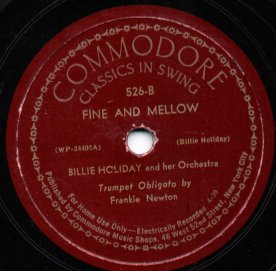
Billie Holiday also recorded for Commodore (in 1939 and 1944), with "Strange Fruit" and "Fine and Mellow" first appearing on that label.
Like his UHCA label, Gabler initially arranged for recording and pressing made by ARC, then Reeves Transcription Services and Decca, so both Commodore and UHCA used various matrix number series, depending on where the session originated from.
After World War II Gabler went to work for Decca Records, and his Commodore label was later used by Decca for reissuing earlier jazz recordings on LP. In the early 1960s a series of Commodore albums were compiled by Gabler and part of the Mainstream label. Mosaic Records issued three LP sets of the label's complete output. - Wikipedia


The whole album is great, even the alternates.  My copy is mint condition and was ripped at 24/44.1 wav, dithered to 16/44.1 FLAC.  The anomolies you may hear are from the source recordings. Aside from that the fidelity on these recordings is brilliant, especially considering the age!!  I am assuming they did some
ripping of their own to get all of this music together!!  Enjoy!!


This attractive two-LP reissue (whose contents have since been reissued in Mosaic's massive Complete Commodore Jazz Recordings box set) consists of four interesting swing sessions. The first two are quite classic. The great tenor saxophonist Coleman
Hawkins is heard with a pianoless sextet in 1940 that also stars altoist Benny Carter and trumpeter Roy Eldridge. Their four selections (plus two alternate takes) are all impressive but it is this brilliant version of "I Can't Believe That You're in Love with Me" (during which Carter takes solo honors) that is most memorable. The other Hawkins date is with a septet from 1943. Trumpeter Cootie Williams and clarinetist Edmond Hall are in fine form, but it is the participation of the remarkable pianist Art Tatum that makes the set particularly historic. The other two sessions, among the final ones for Commodore, showcase Frank Wess (on tenor and 
flute) with a variety of Count Basie's sidemen (including trombonists Henry Coker, Benny Powell and Urbie Green, trumpeter Joe Wilder and pianist Jimmy Jones) on some lightly swinging modern jazz.     -  4.5 / 5  Scott Yanow/AMG

Tuesday, January 1, 2013

Vic Dickenson Septet

Well I hope everybody had a great New Years!!  Me?  Well I took my family downtown for the 'kids' New Years celebration, which included fireworks at 9:00pm.  We had a great time and with the kids in bed, my wife and I quietly brought in the New Year with some 20 year Scotch.

This album is something I am wildly excited to share.
Compilations/reissues of this kind are exactly what we need as jazz fans.  Taking really rare and pricy albums from the past, and making the music available for a reasonable price.

The liner notes are extremely well written, and tell the whole story behind this comp, so I won't go into too much detail.  What I will say is that there is no doubt this music represents Dickenson's greatest contribution to jazz.  This double LP set, released in 1972, was taken from 4 - 10" LPs recorded in the early 50's for the Vanguard imprint.  What we now call mainstream or small group swing, really got it's beginnings from the players on these tracks.  There was a time when the big band players were in a kind of limbo, in between bebop and Dixie.  They managed to carve a niche for themselves, and Dickenson's septet help lead the charge.

Musically, most of the tunes are laid back with a jam-like feel.  The soloing is top notch and inspired.  Luckily, the fidelity is incredible from vinyl which I would categorize as only being very good.  I cleaned it up and the results are excellent.  I think you'll find there's wonderful clarity and the soloists are up front with lots of immediacy.  From what I can tell, this collection was released to CD at some point but definitely appears to be OOP.  Perhaps somebody can shed some light on that for us.  Ripped at 24/44.1 wav and dithered to 16/44.1 FLAC...enjoy the first post of 2013!!!

Vanguard VRS 8520/1
1972

Vol. 1
Vol. 2


Record 1 
Tracks 1 - 5
Vol. 3
Vol. 4


Record 2 
Tracks 6 - 12